Booking choice: The small-group Belém walk, from $38 per person. Check dates Tour details
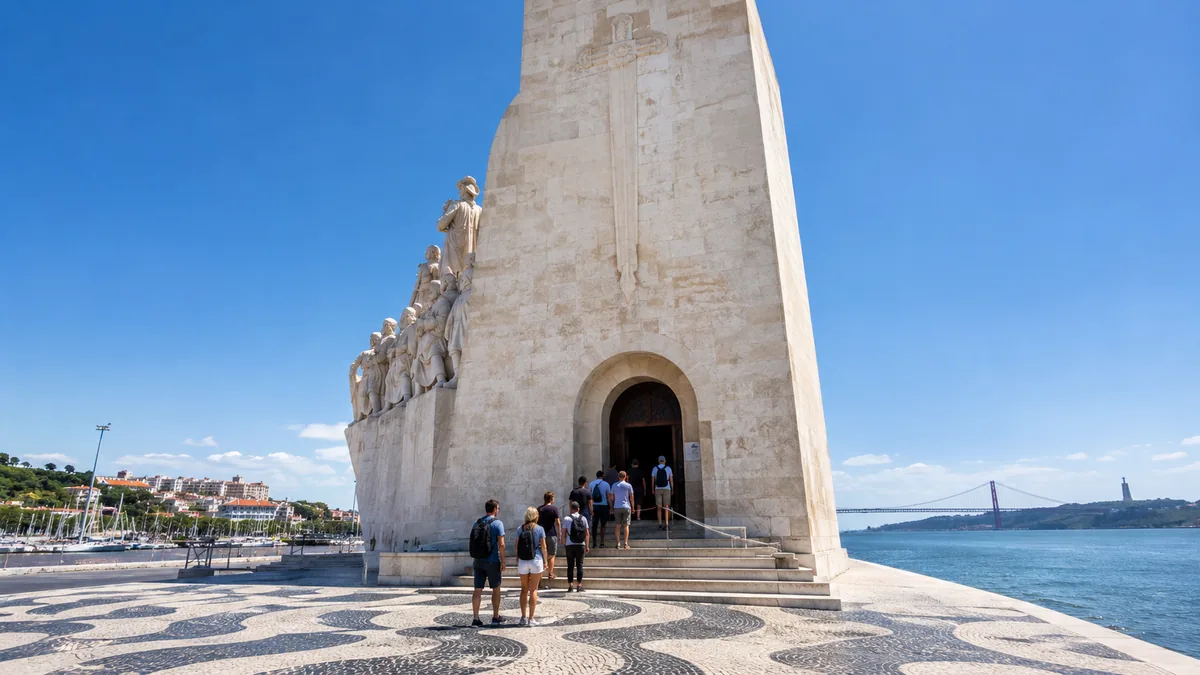
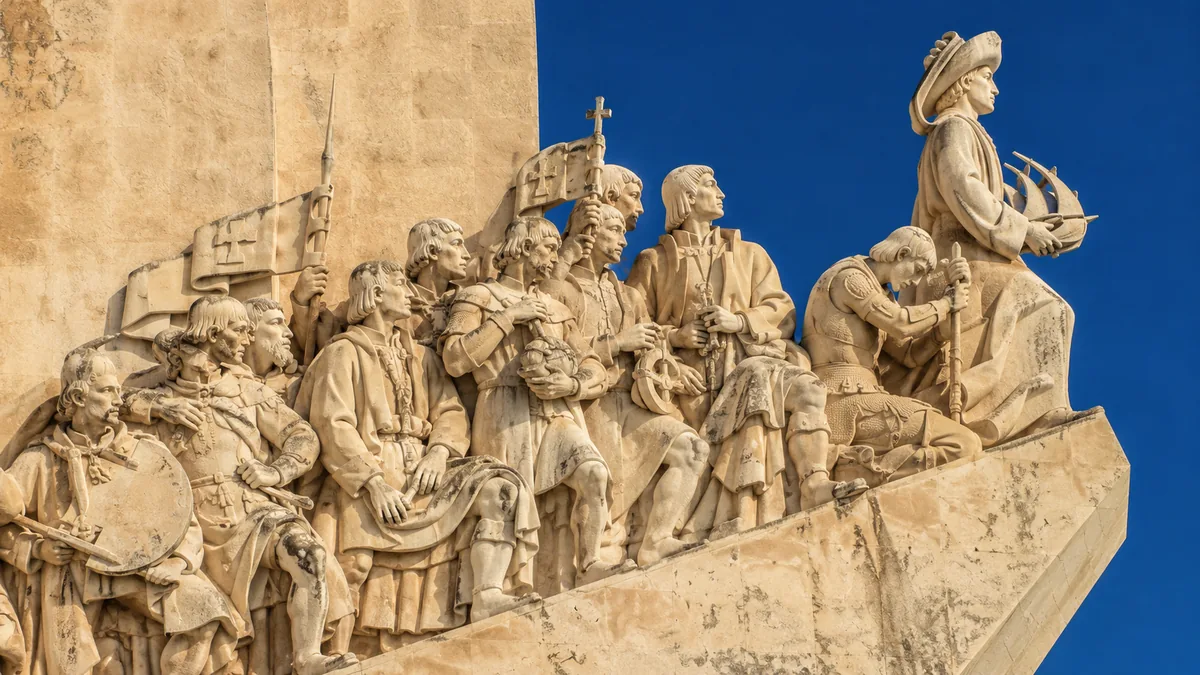
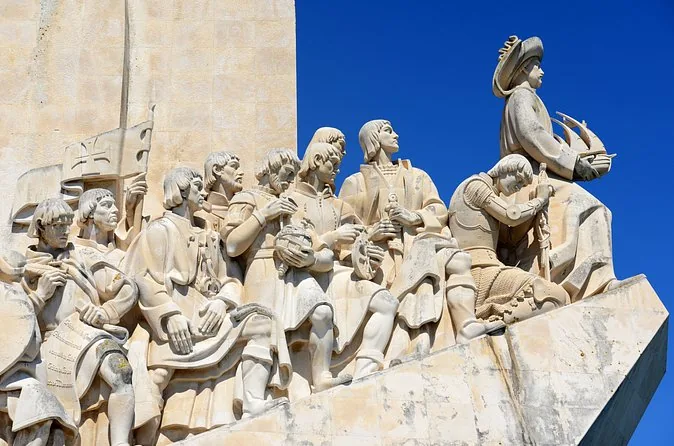
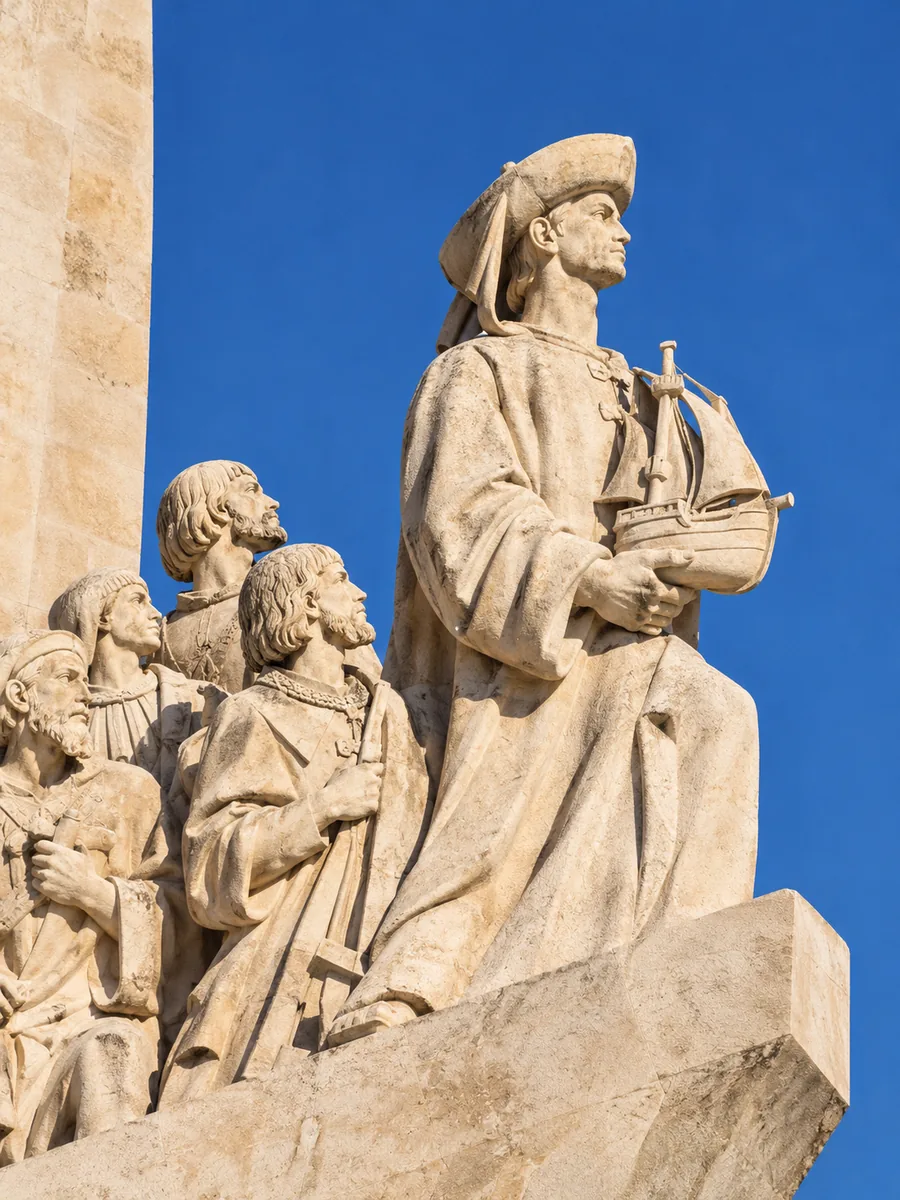
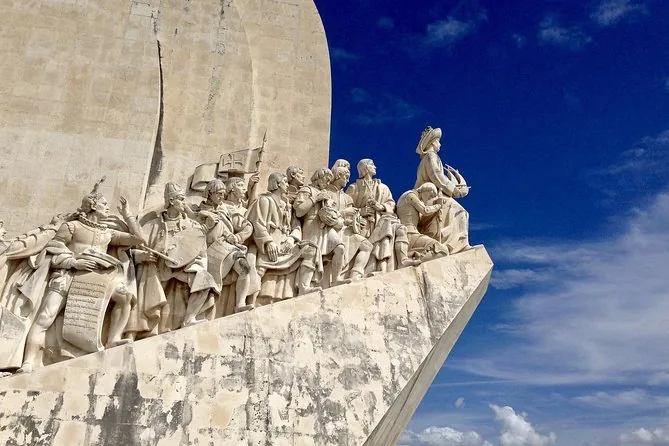
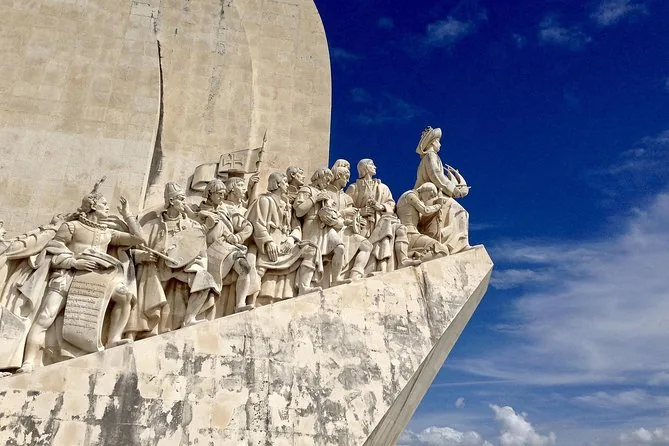
The Padrão dos Descobrimentos, the Monument to the Discoveries, is shaped like the prow of a caravel. Henry the Navigator stands at the front, nine metres tall. Behind him, sixteen figures climb each side of the ramp, seven metres each: navigators, kings, missionaries, a mapmaker, a mathematician, a painter, a poet, and one woman.
The names below follow the list on Wikipedia, read from the land end towards the river. The construction facts come from the monument's own history page.
The quick answer
There are 33 figures: Henry the Navigator at the prow and 16 on each side. The east side is mostly sailors (Vasco da Gama, Cabral, Magellan, Dias, Diogo Cão) plus Afonso V and Francis Xavier. The west side holds Henry's family (Philippa of Lancaster, Pedro, Fernando), Camões, the painter Nuno Gonçalves and the mathematician Pedro Nunes. The statues date from 1960; the 1940 original was plaster.
Who are the figures on the Monument to the Discoveries?
Henry the Navigator plus 32 people from Portugal's Age of Discovery, 16 on each side: navigators, royals, missionaries, chroniclers, scientists and artists.
The monument's own history page sorts them as navigators, cartographers, warriors, colonisers, missionaries, chroniclers and artists, each carved with a symbol that hints at who they are. Sailors hold ropes, swords or a sextant. The missionaries carry crosses. Camões holds his book; the painter holds a palette.
Read them from the land end: the figures furthest from the river are royalty, and the closer to Henry you get, the more famous the voyage. The faces are idealised. Nobody in 1960 knew what most of these people looked like.
Who is on the east side of the Padrão?
Mostly the sea captains: Vasco da Gama, Pedro Álvares Cabral, Ferdinand Magellan, Bartolomeu Dias and Diogo Cão, led from the back by King Afonso V.
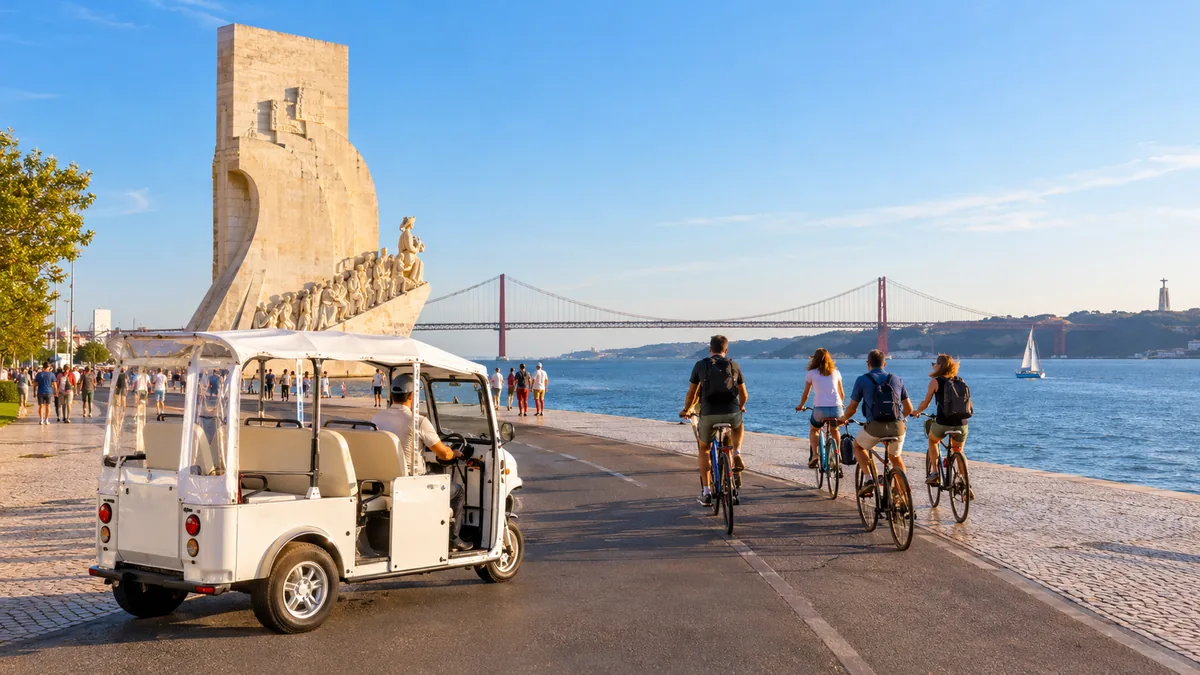
The east side faces downtown Lisbon and the 25 de Abril Bridge. From the land end towards Henry:
| # | Figure | Known for |
|---|---|---|
| 1 | King Afonso V | King who backed the African voyages |
| 2 | Vasco da Gama | First sea route from Europe to India, 1498 |
| 3 | Afonso Gonçalves Baldaia | Navigator on the African coast |
| 4 | Pedro Álvares Cabral | Reached Brazil, 1500 |
| 5 | Ferdinand Magellan | Led the first voyage around the world |
| 6 | Nicolau Coelho | Captain on da Gama's first voyage |
| 7 | Gaspar Corte-Real | Sailed to Newfoundland |
| 8 | Martim Afonso de Sousa | Navigator, early colony in Brazil |
| 9 | João de Barros | Historian of Portuguese Asia |
| 10 | Estêvão da Gama | Sea captain |
| 11 | Bartolomeu Dias | First to round the Cape of Good Hope |
| 12 | Diogo Cão | First European to reach the Congo River |
| 13 | António de Abreu | Navigator in the Spice Islands |
| 14 | Afonso de Albuquerque | Governor of Portuguese India |
| 15 | St Francis Xavier | Jesuit missionary in Asia |
| 16 | Cristóvão da Gama | Captain, Vasco da Gama's son |
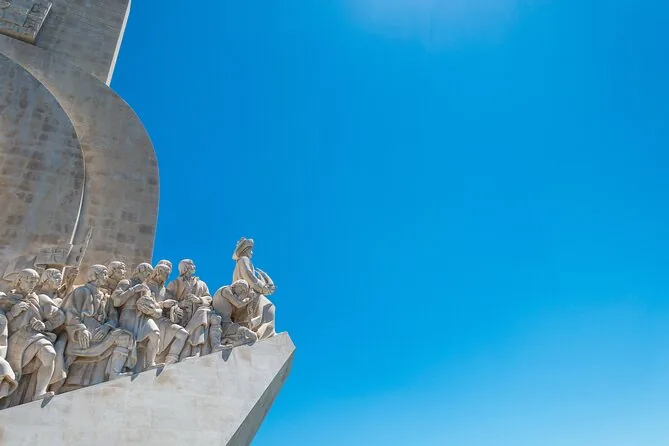
Half an hour at the foot of the monument with a guide who names the figures for you, eight people at most.
Check dates for the small-group Belém walkWho is on the west side of the Padrão?
Henry's family, the scholars and the artists: Philippa of Lancaster, Prince Pedro, Camões, Nuno Gonçalves, Pedro Nunes, plus navigators Gil Eanes and Zarco.
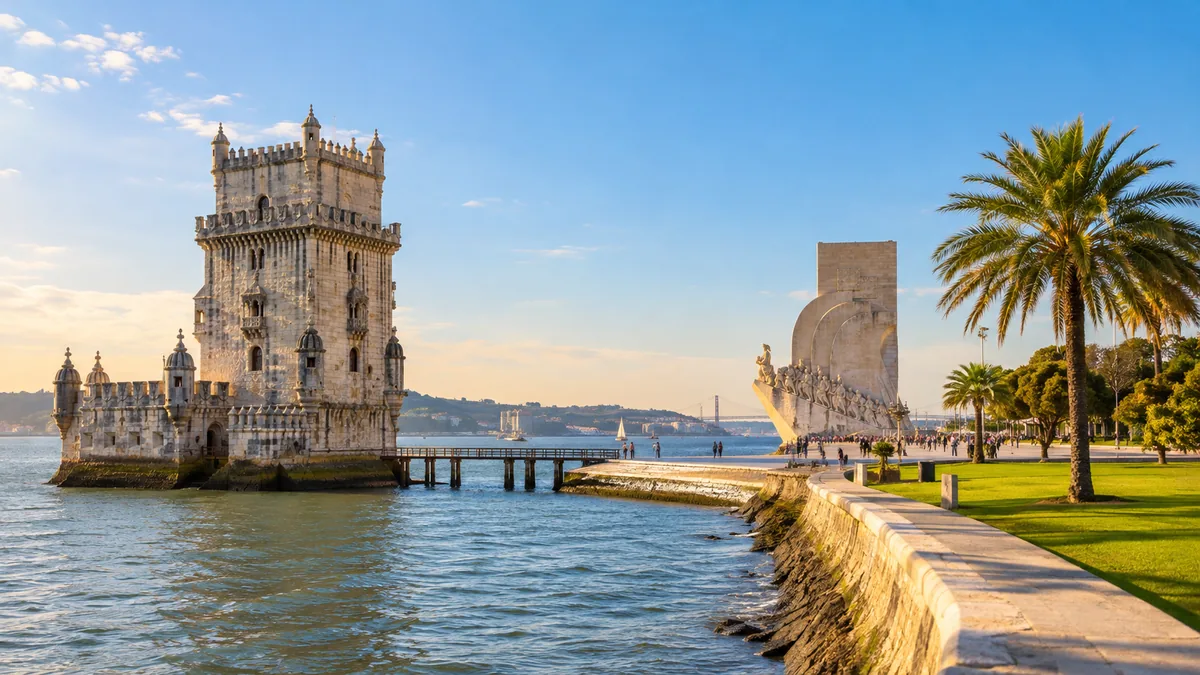
The west side faces Belém Tower. From the land end towards Henry:
| # | Figure | Known for |
|---|---|---|
| 1 | Prince Pedro, Duke of Coimbra | Henry's brother, regent of Portugal |
| 2 | Queen Philippa of Lancaster | Henry's mother, the only woman |
| 3 | Fernão Mendes Pinto | Traveller and writer in Asia |
| 4 | Frei Gonçalo de Carvalho | Dominican missionary |
| 5 | Frei Henrique de Coimbra | Franciscan who said the first Mass in Brazil |
| 6 | Luís de Camões | Poet of The Lusiads |
| 7 | Nuno Gonçalves | Painter |
| 8 | Gomes Eanes de Zurara | Chronicler of the voyages |
| 9 | Pero da Covilhã | Overland traveller to India and Ethiopia |
| 10 | Jácome de Maiorca | Cartographer |
| 11 | Pedro Escobar | Pilot |
| 12 | Pedro Nunes | Mathematician and cosmographer |
| 13 | Pero de Alenquer | Pilot for Dias and da Gama |
| 14 | Gil Eanes | Sailed past Cape Bojador, 1434 |
| 15 | João Gonçalves Zarco | Claimed Madeira |
| 16 | Prince Fernando the Holy | Henry's brother, died a captive in Fez |
Why is Henry the Navigator at the front of the monument?
The 1960 monument was built for the 500th anniversary of his death in 1460. He stands at the prow, nine metres tall, holding a model carrack.
Infante Dom Henrique, son of King João I and Philippa of Lancaster, never sailed on the voyages himself. He organised and funded them from the Algarve in the first half of the 15th century, which is why the monument casts him as the man who launched everything behind him.
The main inscription on the land side reads, in Portuguese, To Infante Dom Henrique and the Portuguese who discovered the sea routes. The other side marks the fifth centenary of his death, 1460 to 1960.
Is Philippa of Lancaster the only woman on the Padrão?
Yes. Queen Philippa, Henry's English-born mother, is the only woman among the 33 figures, second from the land end on the west side.
Philippa was the daughter of John of Gaunt and married King João I in 1387, sealing the alliance between England and Portugal. Three of her sons are on the monument: Henry at the prow, Pedro beside her and Fernando the Holy at the front of the west side. She sits among her family rather than among the sailors, which is the clue to finding her.
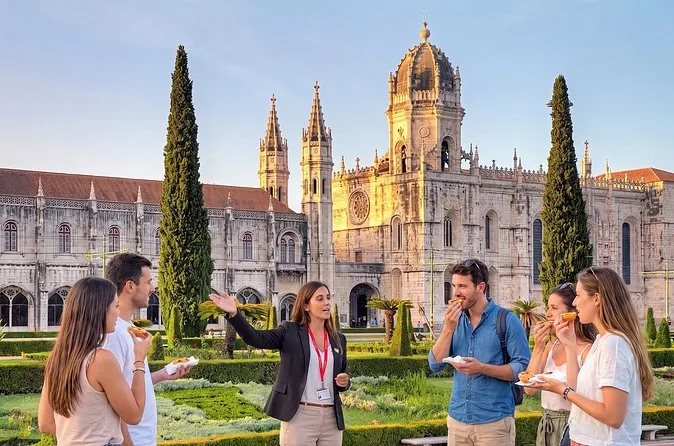
Before the figures, the tomb: the Jerónimos tour takes you to Vasco da Gama's resting place, then 20 minutes at the Padrão to find him again in stone.
Explore the Belém half-day with Jerónimos Tour detailsWhen was the Monument to the Discoveries built, and who designed it?
It was first built in 1940 as a temporary plaster structure, demolished by 1943, and rebuilt in stone from 1958 to 1960. Architect Cottinelli Telmo, sculptor Leopoldo de Almeida.
- 1940: José Ângelo Cottinelli Telmo and Leopoldo de Almeida design a temporary version for the Portuguese World Exhibition, with a light iron and cement frame and statues of plaster and burlap.
- 1943: the plaster version comes down.
- 1958 to 1960: rebuilt for the Henry centenary in concrete faced with rose-tinted Leiria stone, with statues in Sintra limestone. Cottinelli Telmo had died in 1948, so António Pardal Monteiro oversaw the build. Inaugurated on 9 August 1960.
- 1985: the interior opens as a cultural centre with the viewpoint, an auditorium and exhibition rooms.
The finished monument is 56 metres high, 20 metres wide and 46 metres long, with foundations 20 metres deep. Since 2003 it has been run by EGEAC, the Lisbon city council's culture company.
Why was the Padrão built under the Estado Novo?
Both versions were commissioned by Salazar's Estado Novo regime, and the monument presents the Discoveries in the heroic, romanticised way that regime promoted.
The 1940 exhibition was the regime's showcase of national history, and the 1960 rebuild came during the colonial wars that started a year later. Historians read the monument in that light; it shows explorers and missionaries and leaves out the people they met, traded with and enslaved.
The exhibitions inside have looked at the monument itself in recent years. The 2026 show, PADRÃO. House-Obsession, collects the ways the Padrão has been pictured and reused since 1940, with scientific advice from Ellen W. Sapega of the University of Wisconsin-Madison.
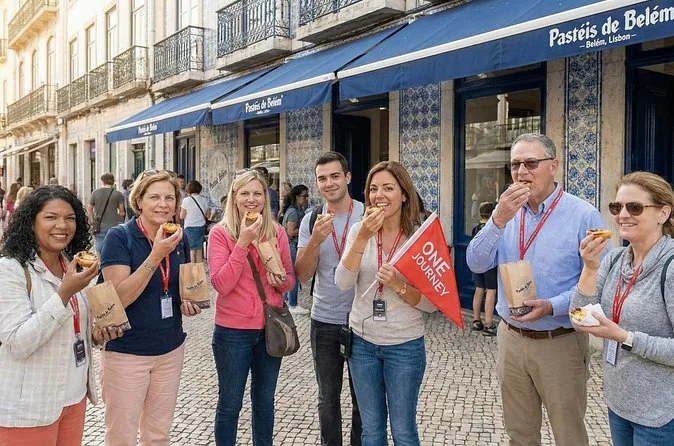
A guided Belém walk with pastéis that puts the monument in its context, in two hours, at the lowest price here.
Check dates for the Belém walk with pastéisWhat is the wind rose in front of the Monument to the Discoveries?
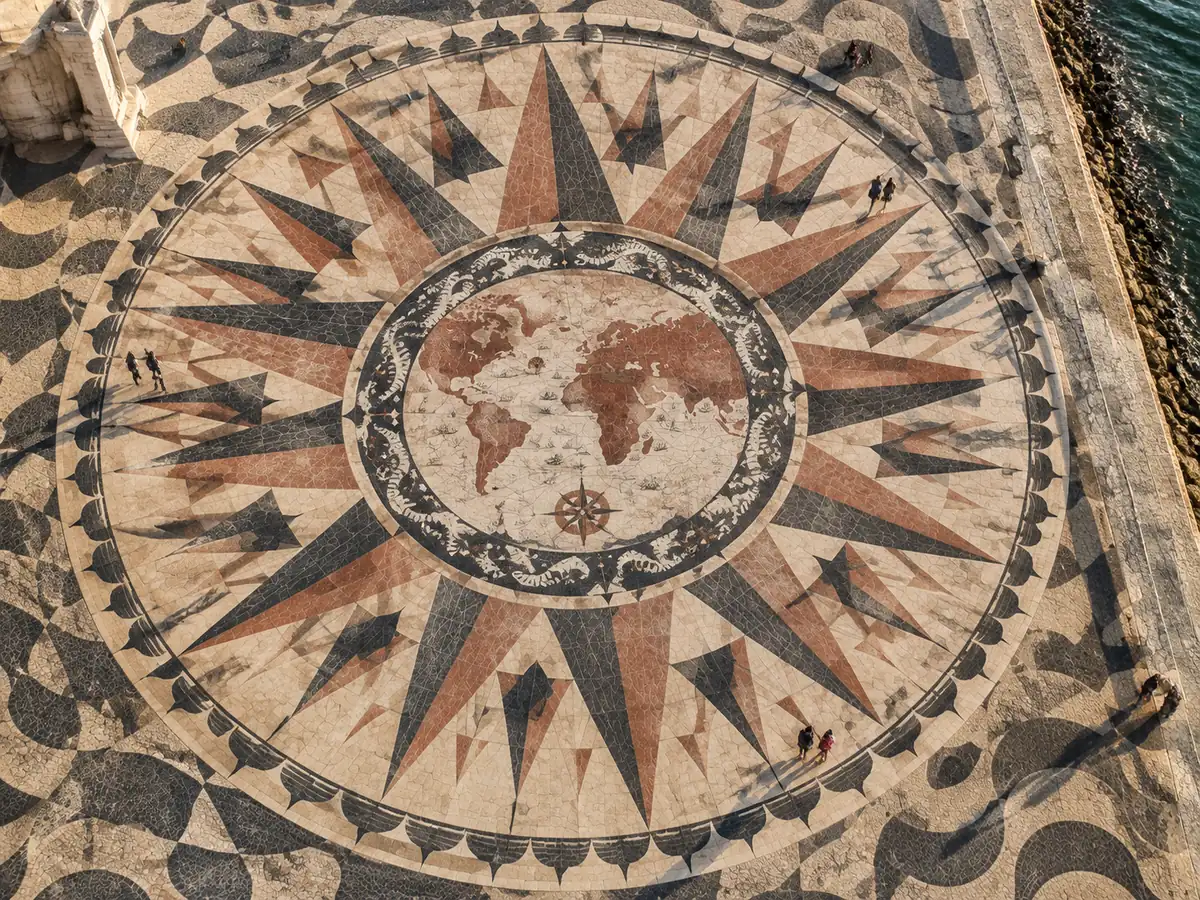
A 50-metre compass rose set in the pavement, a gift from South Africa in 1960, with a 14-metre world map at its centre showing the routes of the Portuguese voyages.
Designed by the architect Luís Cristino da Silva, it is laid in different limestones, including lioz, the cream stone found around Lisbon. The map marks the voyages with their dates, so you can trace da Gama to India or Cabral to Brazil with your feet. It is free and open at any hour.
The best view of it is from the terrace, 42 steps above the lift. Our Padrão tickets guide has the prices and hours for going up.
Frequently asked questions
How many figures are on the Monument to the Discoveries?
33: Henry the Navigator at the prow, and 16 figures on each side of the ramp.
Who is the woman on the Padrão dos Descobrimentos?
Queen Philippa of Lancaster, Henry the Navigator's English-born mother. She is the only woman among the 33 figures, on the west side near the land end.
Is Vasco da Gama on the Monument to the Discoveries?
Yes, second from the land end on the east side, the side facing the 25 de Abril Bridge. His tomb is across the road in the Jerónimos Monastery church.
Is the Monument to the Discoveries from 1940 or 1960?
Both. A plaster version stood for the 1940 Portuguese World Exhibition and was pulled down by 1943. The stone monument you see today was built from 1958 and inaugurated on 9 August 1960.
Ready to book
Choose your tour
Free cancellation up to 24 hours before on every option. Prices are from-prices in USD and move with the season.
Belém & Jerónimos Small-Group Walk
- Professional guide, group of 8 at most
- Pastéis de Belém, the Jerónimos Monastery and Belém Tower
- 30-minute stop at the Padrão (monument entry not included)
Belém Half-Day: Jerónimos Ticket & Pastel Tasting
- Entry ticket to the Jerónimos Monastery cloister
- Church of Santa Maria and the tomb of Vasco da Gama
- Original pastel de Belém tasting
Belém Walking Tour with Pastéis
Two hours of Belém history, pastéis included